Running performance is shaped by a complex interaction of biomechanics, strength, technique, and terrain. While many runners focus on improving endurance or increasing training volume, understanding biomechanical strategies can dramatically enhance speed across different gradients. Whether on level ground, uphill, or downhill terrain, subtle adjustments in form and force application determine how fast a runner can travel efficiently and safely.
This article explores the key biomechanical strategies that help athletes optimize running speed on varying grades, backed by performance science insights and practical application.
Why Biomechanics Matter in Gradient Running
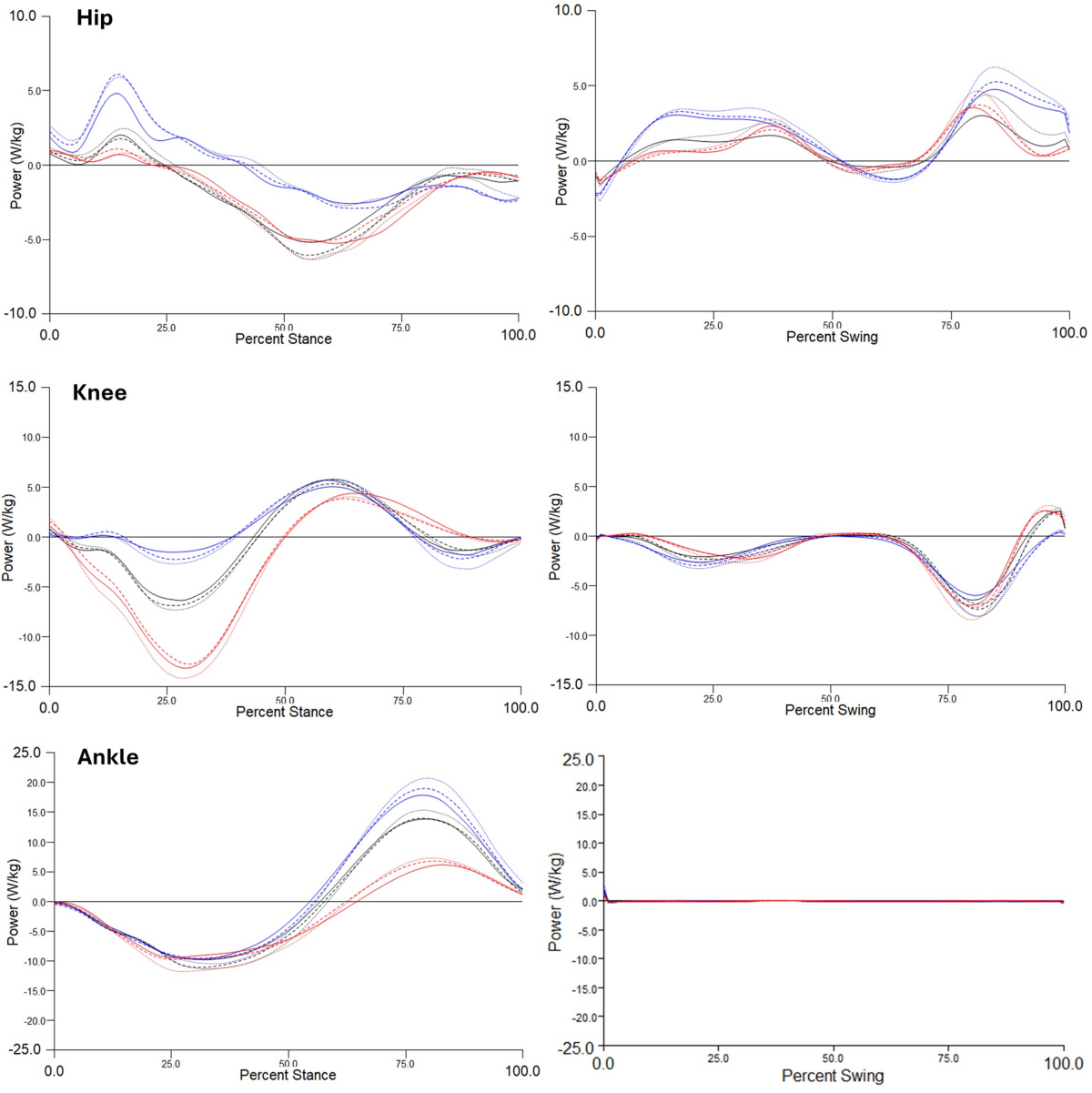
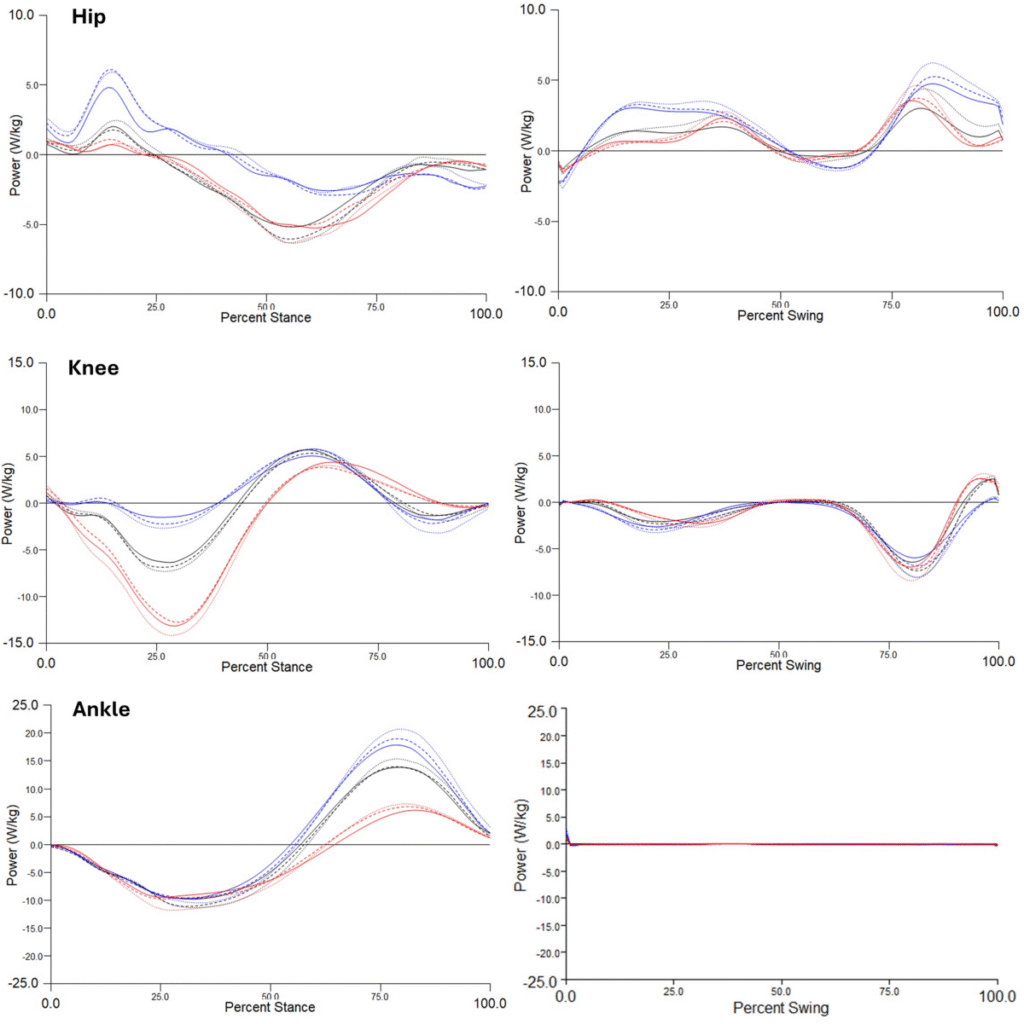
Biomechanics influence how effectively a runner uses energy, generates force, and maintains stability. Terrain changes alter the demands placed on the body:
- Level ground requires optimal stride efficiency and minimal vertical oscillation.
- Uphill running demands greater force production, shorter strides, and increased knee drive.
- Downhill running emphasizes controlled braking, eccentric strength, and longer ground contact times.
Mastering biomechanical strategies for each gradient helps athletes maintain speed while reducing injury risk.
Biomechanical Strategies for Level-Ground Running
Running on flat terrain is the foundation for speed development. Most performance metrics—such as stride efficiency, maximal velocity, and ground contact time—are first optimized here before being adapted to hills or declines.
1. Optimize Stride Length and Stride Frequency
Fast runners find the right balance between stride length and step rate. Overstriding can cause braking forces, while excessively short strides reduce forward momentum.
What to optimize:
- Aim for a cadence around 170–190 steps per minute depending on running speed.
- Maintain a stride length that allows the foot to land close to the center of mass.
Why it works:
Efficient stride dynamics reduce vertical oscillation and improve forward propulsion.
2. Maintain an Efficient Forward Lean
A slight forward lean from the ankles—not the waist—increases propulsion without compromising balance.
Biomechanical advantages:
- Reduces braking forces
- Encourages midfoot landing
- Enhances hip extension and glute activation
This lean should be subtle, natural, and derived from the hips staying neutral.
3. Improve Ground Contact Time and Force Application
Fast level-ground running is characterized by short ground contact times and high force production.
Key strategies:
- Strengthen the posterior chain (glutes, hamstrings, calves)
- Improve plyometric ability
- Increase hip extension power
Lower ground contact time leads to quicker transitions, enabling higher speeds with less wasted energy.
4. Arm Action and Counterbalance
Arms play a crucial role in stabilizing the upper body and influencing stride rhythm.
Optimal form includes:
- Elbows at approximately 90 degrees
- Relaxed shoulders
- Forward-backward arm swing (not crossing midline)
This promotes balance and smooth power transfer across the kinetic chain.
Biomechanical Strategies for Uphill Running
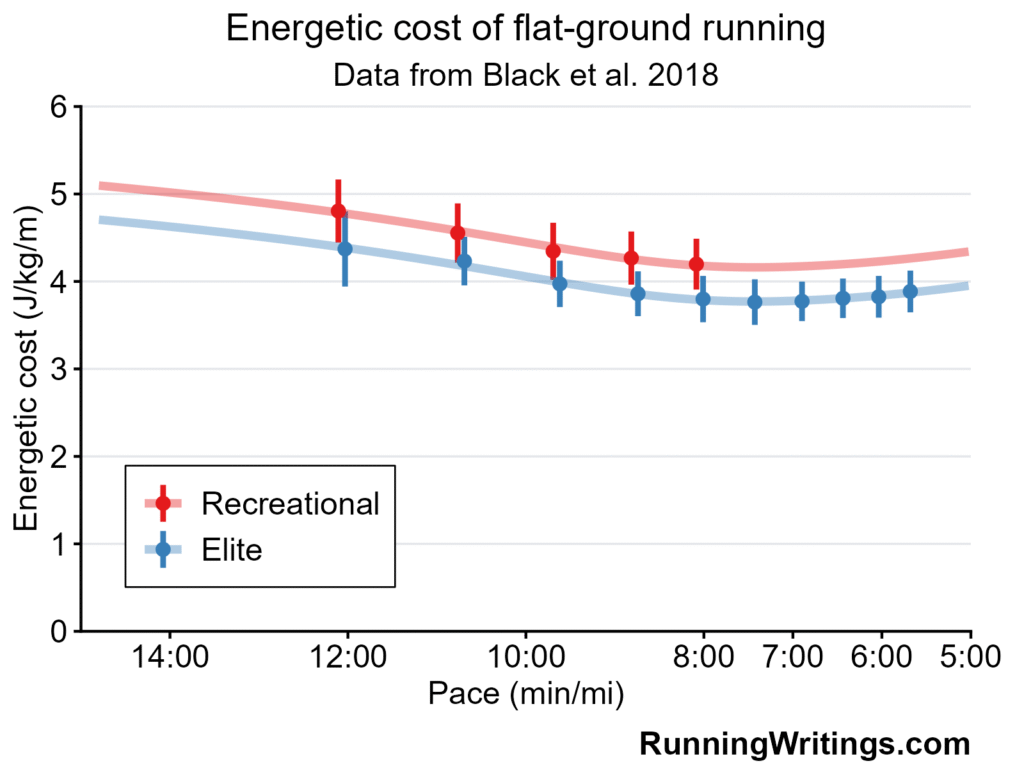
Uphill terrain increases muscular demand and changes body mechanics dramatically. Runners must adjust technique to maintain speed without excessive energy loss.
1. Shorten Stride Length and Increase Cadence
Going uphill requires shorter, quicker steps, similar to a faster walking pattern.
Why it works:
- Shorter strides reduce vertical oscillation
- Higher cadence sustains momentum
- Limits heel striking and excessive ground contact
Athletes who maintain cadence while climbing tend to preserve speed more effectively.
2. Increase Knee Drive and Hip Flexor Engagement
Climbing requires lifting the legs higher to generate upward propulsion.
Focus areas:
- Strong knee lift
- Active hip flexion
- Powerful abdominal engagement for stability
Higher knee drive allows the foot to land beneath the body, improving efficiency on steep grades.
3. Lean Forward Slightly More Than on Level Ground
Uphill running benefits from a more pronounced forward lean—again from the ankles, not the hips.
Biomechanical benefits:
- Improves center-of-mass alignment
- Reduces gravitational resistance
- Enhances glute and hamstring activation
The lean should adjust naturally with the gradient to maintain balance and momentum.
4. Use Active Arm Swing for Propulsion
Arms play a more significant role in uphill running, helping drive the body upward.
Key points:
- Stronger backward arm swing
- Increased rhythm to match cadence
- Relaxed yet powerful movement
The arms help maintain tempo and generate upward momentum, especially when fatigue sets in.
5. Improve Strength and Elastic Power
Biomechanical efficiency uphill is strongly linked to muscular strength.
Important areas to develop:
- Glutes and hamstrings
- Quadriceps
- Calves and Achilles tendon
- Core stabilizers
Hill sprints, stair running, and plyometric drills help generate the force needed for faster uphill speed.
Biomechanical Strategies for Downhill Running
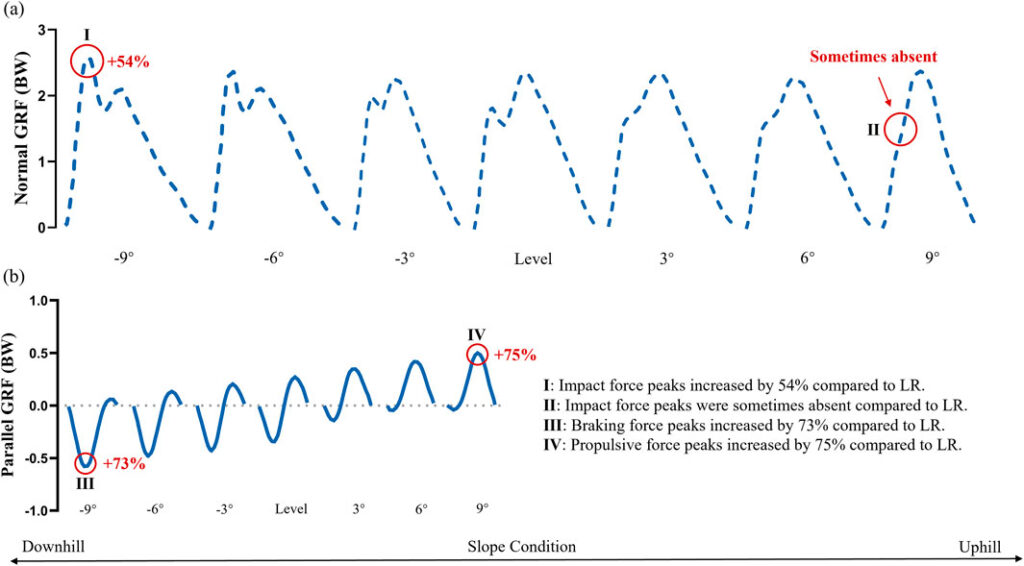
Downhill running allows higher speeds but also increases impact forces and injury risk. Proper biomechanics ensure control, efficiency, and safe acceleration.
1. Lengthen Stride Slightly to Take Advantage of Gravity
Gravity assists downhill momentum, but overstriding creates excessive braking.
Ideal adjustments:
- Slightly longer strides (not exaggerated)
- Maintain cadence
- Allow natural gravity-assisted acceleration
This enhances speed while keeping the foot strike under control
2. Maintain an Upright or Slight Forward Lean
A common mistake is leaning backward, which increases braking forces and stress on the knees.
Correct form:
- Upright torso
- Light forward lean
- Hips aligned over foot strike
This allows the body to move smoothly with gravity rather than resisting it.
3. Increase Knee Flexion and Shock Absorption
Downhill running increases eccentric load—especially in quads and tibialis anterior.
Biomechanical strategies:
- Increase knee bend for impact absorption
- Strengthen quadriceps eccentrically
- Maintain soft, quick foot strikes
These adjustments reduce strain and improve velocity control.
4. Use Rapid Cadence for Stability
Rapid, controlled steps improve balance and reduce the risk of falls or missteps.
Why cadence matters:
- Prevents overstriding
- Improves ground reaction force management
- Supports stable foot placement
Downhill cadence may even exceed level-ground cadence for elite runners.
Training Strategies to Enhance Running Biomechanics
Biomechanics improve most effectively when paired with structured training.
1. Strength Training for All Gradients
- Squats
- Deadlifts
- Lunges
- Calf raises
- Hip thrusts
Strengthening the kinetic chain enhances force production, stability, and injury resilience.
2. Plyometrics for Improved Elasticity
- Bounding
- Hops
- Box jumps
- Single-leg jumps
Plyometrics improve tendon elasticity and ground contact time for level and uphill running.
3. Hill Workouts for Technique Integration
- Short hill sprints
- Steady-pace climbs
- Downhill strides
- Mixed-gradient intervals
Repetition builds neuromuscular familiarity, making form adjustments automatic.
4. Drills for Running Efficiency
- A-skips
- B-skips
- High knees
- Butt kicks
- Stride-outs
These drills reinforce proper mechanics, improve rhythm, and boost speed across all terrains.
Optimizing Biomechanics for Faster Running Across All Terrains
Achieving faster speeds on level ground, uphill, and downhill gradients requires a deep understanding of biomechanical principles. Level-ground running demands efficient stride mechanics, quick ground contact, and forward propulsion. Uphill running requires shorter strides, higher knee drive, and increased force production. Downhill running emphasizes stability, controlled acceleration, and proper shock absorption.
By applying biomechanical strategies tailored to each terrain, runners can enhance speed, reduce fatigue, and minimize injury risk. With consistent practice, strength training, and gradient-specific drills, athletes can unlock their full running potential across any landscape.
Fans can follow updates, live streams, and track maps on SpeedsRun Online and affiliated social media channels.