speedsrun.online Horsepower
By speedsrun staff • Photography & audio design recommended • Updated: Oct 8, 2025
What 500 Horsepower Feels Like
Five hundred horsepower is a technical benchmark that often marks the boundary between brisk performance and full-on, nerve-tingling authority.
In a light, well-tuned coupe it’s a relentless shove out of corners; in a heavy grand tourer it’s a smooth, effortless surge that turns highway merges into statements.
From torque pulses to the long pull
The sensation comes from three elements acting together: instantaneous torque delivery, the transmission’s gear shaping, and chassis tuning that translates engine force into motion without drowning the driver in instability.
When those three are in harmony you get the 500-horsepower symphony—a perceptible sequence of attack, sustain and release that feels musical rather than purely violent.
How the machines deliver it
- Forced induction: Turbos and superchargers take smaller displacements into that 500-hp band without obscene engine sizes.
- Engine tuning: Variable valve timing, rev-by-rev fuel mapping and modern knock control let manufacturers extract reliable power across usable rev ranges.
- Transmission & diff: Fast, predictable shifts and an appropriately biased final drive let you exploit power while keeping the car planted.
Want a deeper tech primer on modern powertrains? Visit our Powertrain Primer at speedsrun.online/gear/powertrain-primer.
Quick Links
Where to Unleash It: Three Legendary Speed Stages
If you’ve got 500 horsepower under your right foot, three types of places will let that power express itself: closed circuit road courses, dedicated speed flats, and modern GP complexes.
Below are three world-class locales — each with a quick map so you can plan a pilgrimage.
Nürburgring (Germany) — Myth & Challenge
The Nürburgring complex—home to the famed Nordschleife—remains a proving ground where high horsepower meets wild topography and unforgiving kerbs.
Enthusiasts and manufacturers alike use it to test durability and drivability at pace. For visiting drivers, the Nordschleife also offers public Touristenfahrten driving days.
Official site: nuerburgring.de
Map: View Nürburgring on OpenStreetMap
WeatherTech Raceway Laguna Seca (USA) — Precision & Drama
Laguna Seca’s legendary corkscrew and short, aggressive straights reward razor-sharp chassis balance and brake control.
This is where 500 hp can be sculpted into corner-exit speed and lap-time poetry.
Official site: weathertechraceway.com
Map: View WeatherTech Raceway Laguna Seca
Bonneville Salt Flats (USA) — Absolute Speed
For top-end velocity and absolute numbers, nothing quite matches the scale and legal history of Bonneville.
The salt flats host land-speed events where the air and surface are the only things resisting a machine’s will to accelerate.
Public-lands info: BLM — Bonneville Salt Flats
Map: View Bonneville Salt Flats
Preparing to Extract the Symphony — Safety, Tires, & Sound
Whether you’re on a closed circuit or a salt course, extracting speed responsibly is as much about prep as it is about audacity.
Here’s a quick checklist:
- Safety gear: Helmet, gloves and racing harness when required by the venue (Laguna Seca sessions and many track days require at least helmet certification).
- Tires & brakes: Fresh rubber and a brake fluid service prior to high-heat sessions; the chassis is useless without grip.
- Audio & telemetry: Record in-car channels (throttle, rpm, GPS) and use them in post to tune gear ratios and launch strategy.
For more on required kit and recommended setups, see our Track Setup Guide.
Join the Run
Speed is best when shared.
If you want this story adapted into a short film, audio piece (engine-symphony mix), or a printable one-page checklist for your next track day, contact us at speedsrun.online/contact.
Have a 500-hp ride you want profiled? Submit it through our Car Submission Form.
Sources & Further Reading
- Nürburgring — official site
- WeatherTech Raceway Laguna Seca — official site
- BLM — Bonneville Salt Flats
- Bonneville — background (Wikipedia)
© speedsrun.online — All rights reserved.
Use of external links does not imply endorsement.
Engineering Innovation: The Heart of the 500-HP Revolution
The leap from 300 to 500 horsepower wasn’t a matter of adding cylinders—it was a paradigm shift in efficiency. Engineers learned to harness computational modeling, laser-precise fuel delivery, and ultra-light alloys that allowed engines to breathe, combust, and cool like never before. This isn’t brute force; it’s symphonic precision.
Aerodynamics: Sculpting the Air
Once you crest the 500-horsepower threshold, air itself becomes both ally and enemy. Designers obsess over downforce coefficients, drag ratios, and underbody airflow. Every vent, splitter, and diffuser plays a note in the high-speed orchestra, keeping the car stable as it slices through resistance at over 250 km/h.
The Soundtrack of Power
There’s a reason enthusiasts describe performance cars as musical instruments. The resonance of the exhaust, the intake harmonics, and the transmission’s whine all combine into a sonic landscape that stirs adrenaline before the car even moves. Modern exhaust tuning—complete with variable valves and acoustic chambers—turns every rev into a crafted performance.
Driver Connection: The Human Interface
500 horsepower is meaningless without a driver who can interpret it. Steering feedback, pedal response, and seat ergonomics become channels of communication. The greatest performance machines feel alive because they make the driver a co-conductor in the mechanical symphony, not just a passenger along for the ride.
The Future of Speed: Electrification and Beyond
The 500-horsepower benchmark no longer belongs exclusively to combustion. Electric powertrains are achieving that figure instantly, silently, and sustainably. The next generation of performance won’t just chase acceleration—it will redefine it, blending raw thrust with zero emissions and precision torque vectoring.
Cultural Impact: The Symbolism of 500 HP
Beyond the racetrack, 500 horsepower has become a cultural shorthand for achievement, aspiration, and freedom. It represents a threshold where engineering meets emotion, and where enthusiasts celebrate the human pursuit of velocity—not just as speed, but as self-expression.
The Genesis of Modern Performance
Before the dawn of turbocharging and hybrid systems, power was earned the old-fashioned way—through displacement. Massive V8s and V12s ruled the road, their weight offset by mechanical bravado. Today, that legacy informs the DNA of every 500-horsepower car, reminding us that speed has always been humanity’s measure of mechanical mastery.
Carbon, Titanium, and the Weight Wars
The pursuit of power means little without control, and control begins with mass reduction. Carbon fiber monocoques, titanium connecting rods, and ceramic brakes all serve the same goal: deliver maximum speed with minimal inertia. Each gram saved amplifies every horsepower, transforming brute strength into agile elegance.
Digital Dynamics: Code Meets Combustion
Behind every modern powerhouse lies millions of lines of code. Engine control units continuously adjust ignition, airflow, and temperature hundreds of times per second. Artificial intelligence now tunes performance dynamically, predicting driver behavior and optimizing torque delivery before the next corner is even in sight.
Climate and Performance: The Atmospheric Equation
Air density, humidity, and ambient temperature can transform a car’s character. A crisp morning in the Alps will yield sharper throttle response and cooler intake temperatures, while a humid desert afternoon saps performance and stresses cooling systems. This is why test drivers chase the perfect atmosphere as passionately as they chase lap times.
Transmission Tactics: The Power Interpreter
Power is useless without precision delivery. The transmission acts as interpreter, translating raw energy into refined acceleration. Dual-clutch systems dominate track performance, but a perfectly engineered manual remains a purist’s dream—a direct handshake with the machine.
Tires: The Silent Heroes
Every horsepower must meet the ground through a few square inches of rubber. Modern compounds blend silica, kevlar, and nanostructured polymers to maintain grip under brutal G-forces. When tuned right, a tire can transform a feral beast into a ballet dancer, tracing perfect arcs through corners.
Fuel Evolution: From Octane to Electricity
The transition from fossil fuels to electric propulsion is reshaping how we define horsepower. Hydrogen fuel cells, e-fuels, and high-density lithium packs all aim for the same target: limitless acceleration with zero compromise. The combustion symphony may quiet, but the melody of speed will remain eternal.
Design Language: Form Follows Fury
The world’s fastest machines aren’t just functional—they’re visual declarations of motion. Wind tunnels inform every curve and contour, sculpting bodies that slice through resistance. The most beautiful designs achieve harmony between aggression and grace, expressing speed even when standing still.
Brakes: The Unsung Virtuosos
Braking systems are often overshadowed by power figures, yet they’re what make speed usable. Carbon-ceramic rotors, six-piston calipers, and adaptive ABS systems dissipate energy with surgical control. Mastering deceleration is the truest art of performance driving.
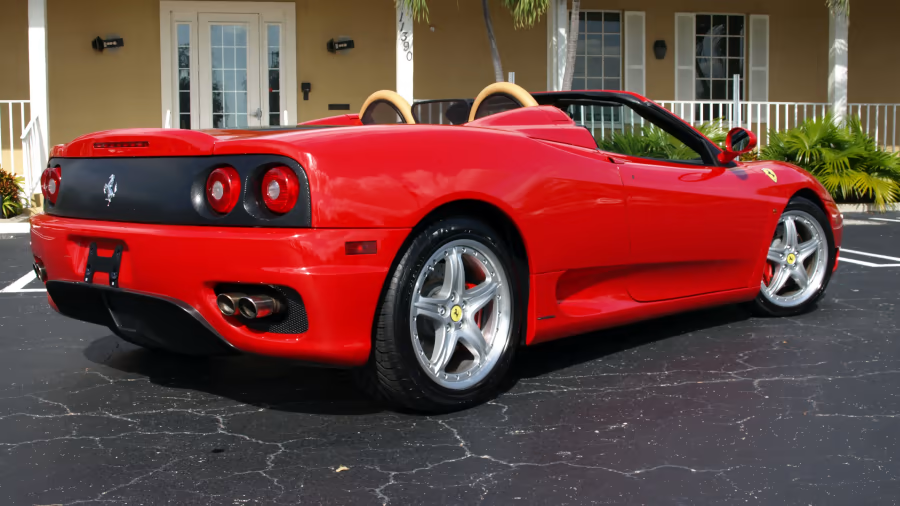
Heritage Machines: Legends of the 500 Club
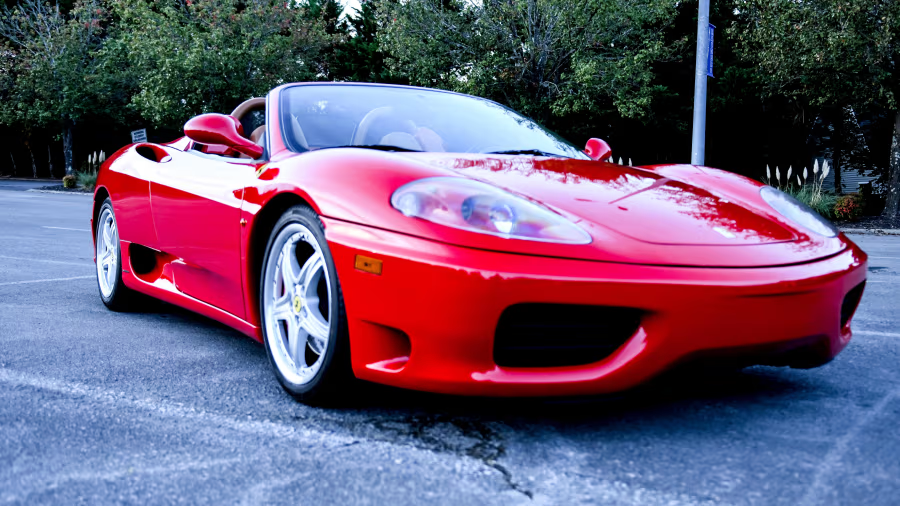
Icons like the Ferrari F430 Scuderia, Porsche 911 Turbo, and Nissan GT-R defined what 500 horsepower could mean across eras. Each approached performance from different philosophies—Italian passion, German precision, and Japanese innovation—but together they built the mythology that still inspires every supercar today.
Sound Sculpture: The Art of Engine Acoustics
Engine sound is no accident—it’s engineering theatre. Acoustic engineers model exhaust note frequencies, shaping resonance chambers like musical instruments. From AMG’s guttural bass to Ferrari’s treble shriek, every sound signature is an identity, not just a byproduct of combustion.
AI Assistance: The Invisible Co-Pilot
Adaptive control systems now predict understeer before it happens, applying individual wheel braking and torque redistribution in milliseconds. The result is supernatural stability—allowing drivers to push the edge of physics without crossing the line into chaos.
Data and Telemetry: Racing’s New Language
Track data has become the new dyno sheet. Every lap generates gigabytes of telemetry—tire temps, throttle traces, steering angles— which engineers translate into performance improvements. This feedback loop turns each drive into an evolution, refining both machine and driver.
Simulators: Training in the Digital Realm
Before tires touch tarmac, drivers now train in hyper-realistic simulators. These digital twins replicate car physics down to suspension flex and tire deformation. By the time a test driver reaches the real circuit, their reflexes are already tuned to perfection.
Lightweighting Philosophy: Subtraction as Art
In the pursuit of performance, sometimes less truly is more. Stripped interiors, magnesium components, and minimalist design language remove distractions, letting the car’s essence—speed itself—take center stage.
Electrification: The New Age of Instant Power
Electric vehicles redefine the concept of power delivery. Instant torque means no waiting, no lag—just unbroken acceleration. As battery technology advances, 500 horsepower will soon be the baseline, not the summit.
Sustainability Meets Speed
The future of high performance depends on environmental responsibility. Recyclable composites, bio-based fuels, and regenerative systems are transforming how cars deliver excitement while preserving the planet that gives us roads to explore.
Ergonomics: Command in Comfort
Every button, paddle, and pedal is placed with intent. Performance ergonomics balance precision and comfort, ensuring that even at 300 km/h, the driver remains composed and in control.
Luxury and Performance: A Harmonious Duality
Once, comfort diluted speed. Today, craftsmanship complements it. Alcantara, carbon trim, and digital dashboards create cabins that stimulate both adrenaline and serenity—a fusion of speed and sophistication.
Night Driving: Speed in Silence
When the world sleeps, open roads transform into private symphonies of motion. Adaptive LED lighting, night vision systems, and radar-assisted cruise control elevate night drives into surreal experiences where power feels infinite.
Aero Tech: Managing Pressure and Flow
Active aero systems, once reserved for race cars, now adapt in real time on road vehicles. Rear wings rise and fall, air channels open, and splitters flex—all managed by on-board computers chasing perfect balance between drag and downforce.
Interior Acoustics: The Sound of Serenity
Engineers now tune cabin acoustics like recording studios. Active noise cancellation and harmonic dampers allow occupants to choose their soundtrack: peaceful silence or unfiltered engine roar at the push of a button.
Collectibility and Value: The 500-HP Investment
Limited production runs and hybrid-era transitions are turning 500-horsepower icons into collectibles. Their blend of analog feel and modern reliability makes them timeless assets, coveted by enthusiasts and investors alike.
Tuning Culture: Personalizing Power
The tuning world thrives on individuality. ECU remaps, upgraded turbos, and custom exhausts let enthusiasts fine-tune performance to their own rhythm. Each build becomes an expression of taste, skill, and mechanical artistry.
Global Tracks Worth the Flight
From Suzuka to Spa, the world offers circuits that challenge even the most seasoned drivers. Each track has a character—a rhythm of corners, elevations, and straightaways—that tests both machine and mind.
Community and Camaraderie: The Brotherhood of Speed
Speed unites people across generations and borders. From local track meets to international rallies, the 500-horsepower crowd celebrates shared passion and craftsmanship. It’s more than performance—it’s belonging.
Legacy of Motion: What Speed Leaves Behind
Beyond numbers, dyno charts, and telemetry, speed leaves an imprint on culture. Every innovation, every engine note, every victory lap becomes a page in humanity’s story of progress. 500 horsepower isn’t just a figure—it’s a philosophy.
Frequently Asked Questions About Horsepower
1. What is Horsepower and why is it important?
Horsepower is a unit of measurement that defines an engine’s ability to perform work over time. In simple terms, it tells you how fast your vehicle can apply its power to move. The higher the Horsepower, the more energetic and responsive your vehicle feels.
2. Who invented the term Horsepower?
The term “Horsepower” was coined by Scottish engineer James Watt in the late 18th century. He created it as a relatable way to explain the power of his steam engines compared to horses, which were the standard work measure of the time.
3. How is Horsepower calculated?
Horsepower is typically calculated using the formula: (Torque × RPM) ÷ 5252. This shows the relationship between rotational force (torque) and engine speed (RPM), both of which directly affect total output power.
4. What’s the difference between Horsepower and Torque?
Torque measures the twisting force that initiates movement, while Horsepower measures how quickly that force is applied over time. High torque gives strong acceleration, but Horsepower determines top speed and sustained performance.
5. How much Horsepower does a typical car have?
Most modern sedans have between 150 and 250 Horsepower. Sports cars usually start around 300 Horsepower, while high-performance vehicles and supercars can easily exceed 500 Horsepower or more.
6. Is more Horsepower always better?
Not necessarily. While more Horsepower can deliver faster acceleration and higher top speeds, handling, weight distribution, and traction are equally important. Too much Horsepower without proper control systems can reduce real-world usability.
7. What’s considered high Horsepower in today’s standards?
In today’s automotive world, anything above 400 Horsepower is considered high-performance. Hypercars and EVs like the Tesla Model S Plaid and Bugatti Chiron exceed 1,000 Horsepower, pushing the limits of engineering and traction technology.
8. How do electric cars measure Horsepower?
Electric motors still use Horsepower as a performance unit, but it’s derived from electrical power output instead of mechanical combustion. EVs often feel faster than their Horsepower rating suggests because torque is delivered instantly.
9. Can Horsepower be increased through tuning?
Yes. ECU remapping, forced induction (turbo/superchargers), and upgraded exhaust systems can increase Horsepower significantly. However, modifications must be balanced with drivetrain and cooling upgrades to ensure reliability.
10. What’s the difference between Brake Horsepower (BHP) and regular Horsepower?
Brake Horsepower, or BHP, measures an engine’s output before losses from accessories like the gearbox, alternator, or exhaust. It represents the engine’s raw potential, while net Horsepower refers to the actual power delivered to the wheels.
11. How does Horsepower affect fuel efficiency?
Higher Horsepower usually means more fuel consumption, especially under aggressive driving. However, modern engines with turbocharging and hybrid systems can balance high Horsepower with efficient fuel usage by optimizing combustion.
12. Why do some lightweight cars feel faster with less Horsepower?
Power-to-weight ratio is key. A light car with 300 Horsepower may accelerate faster than a heavy car with 500 Horsepower because there’s less mass to move. This balance defines true performance more than raw numbers.
13. Does Horsepower affect top speed?
Absolutely. Top speed depends on both Horsepower and aerodynamic efficiency. The more Horsepower available to overcome drag at high speeds, the higher the vehicle’s maximum velocity potential.
14. How do manufacturers test Horsepower?
Manufacturers measure Horsepower using a dynamometer (dyno), which simulates load and resistance while tracking torque and RPM data. This ensures accurate, repeatable results before publishing performance figures.
15. What’s the future of Horsepower in electric and hybrid vehicles?
The future of Horsepower lies in electrification. Electric vehicles produce instant torque and scalable power output without traditional engine limits. As battery and motor tech evolve, Horsepower ratings will continue to climb while emissions fall dramatically.